

Mars Rover Discovery: NASA's Latest Findings Point to Ancient Microbial Life on the Red Planet
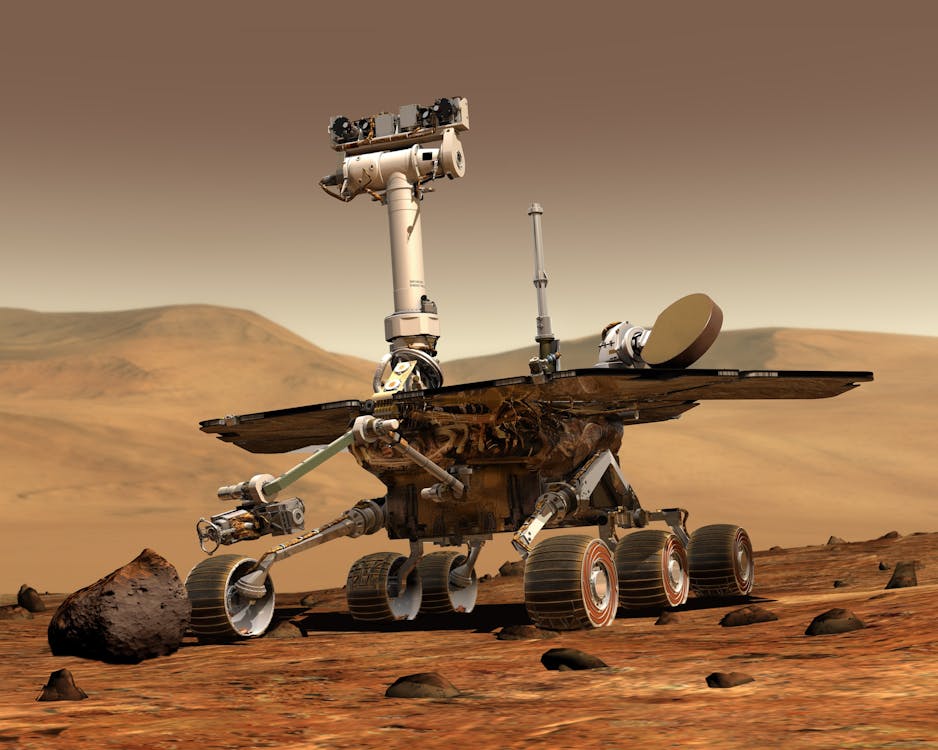
In a groundbreaking announcement, NASA's Mars rover has uncovered compelling evidence suggesting the existence of ancient microbial life on the Red Planet. The Curiosity rover, equipped with state-of-the-art scientific instruments, has been tirelessly exploring the Martian landscape, and its latest findings are poised to revolutionize our understanding of the potential for life beyond Earth.
The revelation comes after years of meticulous analysis of Martian soil and rock samples collected by the rover. NASA scientists, gathered in anticipation at the Jet Propulsion Laboratory (JPL) in Pasadena, California, delivered the exciting news during a press conference that drew the attention of the global scientific community and the general public alike.
Dr. Katherine Turner, the lead astrobiologist on the mission, began the announcement with a sense of cautious excitement. "Our findings suggest the presence of organic molecules and isotopic signatures that are indicative of microbial life. While we are not claiming definitive proof just yet, the evidence is compelling and raises the tantalizing possibility that Mars may have once harbored life."
The discovery revolves around the analysis of sedimentary rocks in the Gale Crater, where the Curiosity rover has been exploring since its touchdown on Mars. Scientists identified distinct patterns in the composition of certain rocks, including organic molecules such as amino acids and lipids. These molecules, crucial for the formation of life as we know it, were found in concentrations that deviate significantly from the surrounding geology.
Moreover, the team observed a consistent isotopic pattern in the carbon compounds within these rocks, a signature that closely resembles biological processes seen on Earth. The combination of these factors led the scientists to cautiously propose the existence of ancient microbial life on Mars.
The rocks in question date back to a time when Mars is believed to have had liquid water on its surface, a key ingredient for the development and sustenance of life. The Curiosity rover's findings align with the hypothesis that Mars may have once supported microbial life in its distant past.
Dr. Turner emphasized the importance of the discovery, stating, "This is a paradigm-shifting moment in our exploration of Mars. While we have previously speculated about the possibility of life on the Red Planet, the evidence we are presenting today takes us one step closer to answering one of humanity's greatest questions: are we alone in the universe?"
The scientific community is buzzing with excitement, and researchers around the world are eager to scrutinize the data and replicate the findings. Collaborative efforts between NASA and international space agencies are already underway to send more sophisticated equipment to Mars for further investigation.
Dr. Raj Patel, a prominent astrochemist at the European Space Agency (ESA), expressed his enthusiasm, "This discovery has profound implications for astrobiology and the search for extraterrestrial life. It opens up new avenues for exploration and underscores the need for future missions to delve deeper into the Martian surface."
While the news is met with widespread excitement, scientists are quick to caution against jumping to conclusions. Dr. Emily Thompson, a planetary geologist involved in the mission, emphasized the need for rigorous peer review and additional experiments. "Scientific discovery is a gradual process, and we must ensure that our conclusions are based on robust evidence. The possibility of microbial life on Mars is an extraordinary claim that demands extraordinary evidence."
The Curiosity rover will continue its mission, collecting additional samples and conducting further analyses to corroborate the initial findings. NASA is also planning future missions, including the Perseverance rover, set to explore the Jezero Crater, a location believed to have once housed a lake that could have supported ancient life.
As news of the potential discovery reverberates across the globe, public interest in space exploration has reached new heights. Social media platforms are flooded with discussions and speculations, and the hashtag #LifeOnMars is trending worldwide.
The discovery raises philosophical and existential questions about our place in the universe. If microbial life once thrived on Mars, what does that mean for the broader search for extraterrestrial intelligence? Are the building blocks of life common throughout the cosmos, or is Earth a unique oasis of life in an otherwise barren universe?
Ethical considerations also come into play. As humanity inches closer to the prospect of discovering life beyond Earth, discussions about the responsible exploration and potential contamination of other planets are gaining prominence. Scientists and policymakers are contemplating how to approach future missions to avoid interference with potential extraterrestrial ecosystems.
In the wake of this monumental announcement, space agencies and private entities are reassessing their plans for Martian exploration. The tantalizing prospect of finding conclusive evidence of past or even present life on Mars has injected new momentum into the quest for answers about the mysteries of our neighboring planet.
The implications of the Mars rover discovery extend beyond the realm of science fiction. The possibility of ancient microbial life on Mars is a significant step toward unraveling the cosmic tapestry and understanding the potential for life beyond our home planet. As the scientific community eagerly awaits further data and analysis, humanity stands at the precipice of a new era in space exploration, one that may reshape our perception of the universe and our place within it.



No comments: